KRISHNA JANAMASHTAMI 2023
Happy Kṛṣṇa Janamshtami to all – From the Vedic Wisdom of the Fixed Stars Nakṣatras for week of 6th Sept 2023 Kṛṣṇa spent days in Goloka, and where he met Radha there. He is also often called with name Gopal, Govinda, Gopalpriya meaning lover of cow herds. He also picked up the mountain Govardhan, also called Gauranga, and his devotees are often assigned names such as Gauranga das or Goswami. So what is the Beeja of Ga that is so powerful?
Divine Discontent of Veda Vyāsa Rishi and advise of Narada
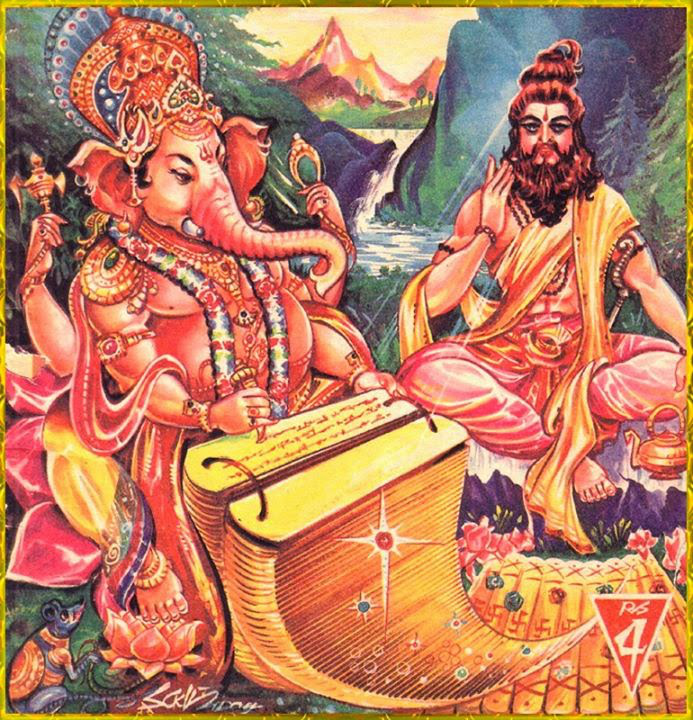
In spite of having compiled such a huge works as Mahābhārata, Vedas, etc., Vyāsa felt that something was lacking. This is the reason it was written by Vyasadeva because he felt dissatisfied having described only dharma, artha, kama and moksha, the four main aims or pillars of human existence.
Nārada Muni noticing his dissatisfaction said to him –
“O best of sages, since you have broadly described the four goals of human life beginning with religious performances, you have not described the glories of the Supreme Personality, Vasudeva.” (Bhagavata1.5.8-9)
Then, Nārada told him that he should compose a devotional scripture mainly dealing with the pastimes of Bhagavat, i.e. Lord Kṛṣṇa. Vyāsa did eventually compose the Bhāgavata or Śrīmad Bhāgavata Purāṇa, upon completion, could not write anything more. Why? As his mission was complete and the initial dissatisfaction disappeared! Why is this epic work of Ved Vyasa, so pertinent in today’s day and age?
As the whole of the Bhāgavata Purana is to do with Bhagvatas, Lord’s ardent devotees.
प्रह्लाद नारद पराशर पुंडरीक
व्यासांबरीष शुक शौनक भीष्म दाल्भ्यान् ।
रुक्मांगदार्जुन वसिष्ठ विभीषणादीन्
पुण्यानिमान् परम भागवतान् स्मरामि।।
prahlāda nārada parāśara puṃḍarīka
vyāsāṃbarīṣa śuka śaunaka bhīṣma dālbhyān .
rukmāṃgadārjuna vasiṣṭha vibhīṣaṇādīn
puṇyānimān parama bhāgavatān smarāmi..
I remember and meditate upon the Bhāgavatas
(Lord’s ardent devotees) Prahlada, Narada, Parasara, Pundarika, Vyasa, Ambarisha, Śuka, Shaunakha, Bhishma, Rukma, Angadha, Arjuna, Vashishta, Vibhishana – all these virtuous souls.
Śuka (also called Śukadeva) was a son of Vyāsa. He was born perfect, did not need any guru or initiation to attain enlightenment because he already was an emancipated soul. As a teenager, he left his home and started wandering about as a sannyāsī (one who renounces all worldly activities).
At that time, there was also a great monarch called Parīkṣit. He was a virtuous king and the only one who could prevent the upcoming Kaliyuga (age of quarrel or discord) from entering.Essentially, Kali Yuga was not allowed to enter as long as King Parīkṣit was around…
(A little on the ancient Kali yuga – Indian Astronomy
As per the Vedic knowledge, there are four ages or yuga-s: Kṛta or Satya (1,728,000 human years), Tretā (1,296,000 human years), Dvāpara (864,000 human years) and Kali (432,000 human years). The former (Kṛta or Satya) is the most virtuous yuga, while the latter, viz. Kali, is the worst one! Naturally, this is the Yuga we are all labouring under.
The four ages comprise a period of 4,320,000 human years, which is known as Mahāyuga or Great Yuga. In turn, 1,000 Mahāyuga-s (4,320,000,000 human years) constitute a Kalpa (12 hours of Brahmā, the god creating the universe). Thus, a day of Brahmā lasts 8,640,000,000 human years. Brahmā lives 100 years and each of those years contains 360 days. Thus, Brahmā lives the a staggering quantity of 311,040,000,000,000 human years. Currently, Brahmā is 51 years old.
Hence the idea that in this Kali Yuga.)
There is only one God head or supreme being that can relieve us of the constant suffering and calamities. That is Krsna.
So actually, the whole purpose of Bhagavatam is the glorification of Krishna and establishing of Bhakti.
Anyways back to the great monarch called Parīkṣit. He was a virtuous king and the only one who could prevent the upcoming Kaliyuga (Age of Strife, discord, evil and suffering) from entering.
Hence the idea that in this Kali Yuga, there is only one God head or supreme being that can relieve us of the constant suffering and calamities. That is Krsna.
So actually, the whole purpose of Bhagavatam is the glorification of Krishna and establishing of Bhakti.
Back to the Story, Kaliyuga needed to enter this world, but king Parīkṣit stood in the way. Parīkṣit was a son of Abhimanyu, a son of Arjuna himself. Hence, he was a grandson of Arjuna, one of the five celebrated Pāṇḍavas who won the Mahābhārata war.
Parīkṣit was also great-great-grandson of Vyāsa.
As a result, Kaliyuga had to lay a trap for Parīkṣit in order to get rid of him. One day, king Parīkṣit was hunting in a forest. As he was really very thirsty, went to a nearby hermitage for some water. In that hermitage there was a sage called Śamīka engrossed in deep meditation. The king asked that sage for a little water several times, but Śamīka did not respond at all due to his state of samādhi. Parīkṣit got extremely angry with the sage and, taking a dead snake, placed it, around the Śamīka’s neck in order to show his wrath. Śamīka was a priest – brāhmaṇa and Parīkṣit had always paid homage to priests. But under the influence of Kaliyuga, which was making its way as a dark cloud, making his head, intelligence cloud in perfect judgement. Any wonder, Parīkṣit lost his temper and made a great mistake.
Of course, Śamīka, the sage, kept meditating as if nothing had occurred.
When Parīkṣit returned his palace and removed his golden crown from his head, realized the great sin he had committed, but was too late to change the course.

Meanwhile, the son of Śamīka called Śriṅgī, returned to the to his father’s abode and was horrified to see a dead snake around his neck, got really furious and uttered a curse: “Whomsoever has done this will die by the bite of Takṣaka himself (one of the three great Serpents of immense power) in seven days”.
Afterward, Śamīka came out at last of his samādhi and learnt how his son had thrust a curse upon Parīkṣit.
As the curse could not be stopped, the sage told Śriṅgī to inform Parīkṣit about it.
At the moment Parīkṣit was informed, he felt very elated, as he now knew the exact time of his death and might put the remaining time to good use.
And he did so: he left all behind his entire kingdom, family and wealth, riches and went to the banks of river Ganges to meditate on the Lord and wait for his inevitable death. When all sages became aware of their king’s destiny, they rushed to that place to accompany Parīkṣit during his last seven days.
Śuka, the son of Vyāsa who had left his home and was wandering around as a sannyāsī. Śuka also called Śukadeva, was a son of Vyāsa. He was born perfect, did not need any guru or initiation to attain enlightenment because he already was an emancipated soul.
He went to that place on the banks of Ganges too. When Parīkṣit saw Śuka, he immediately asked him about what a man on the point of dying should perform. Śuka was glad about such a question and started his narration of the Śrīmad bhagavata purāṇa, which he had learnt from his father, Vedavyāsa. The narration continued for seven days continuously without interruption.
When Takṣaka, the great Naga arrived on the seventh day, killed Parīkṣit finally, but the in other times king had already attained complete body detachment and enlightenment. At last, eventually Kaliyuga could enter!
Sūta, the son of Rishi Romaharṣana was one of those sages assembled on the banks of Ganges. He heard the entire narration of the Bhāgavata by Śuka and learnt it by heart.
Later on, a group of wise men met in the sacred Naimiṣa forest. These sages were headed by Śaunaka. Thus, by the grace of Sūta, not only did the sages and Śaunaka, were overjoyed in listening to the bhagvata but also, paved way for Modern times, this magnificent Purāṇa.
Srimad Bhagavatam teaches nine primary forms of bhakti as explained by Prahlada as:
(1) śravaṇa is listening to the scriptural stories of Kṛṣṇa and his companions) Jupiter
(2) kīrtana is praising, singing the Lord’s glories), Venus
(3) smaraṇa is remembering or fixing the mind on Viṣṇu at all times – this is a tough one, as most people’s minds stray to mundane material existence invariably. Moon
(4) pāda-sevana is rendering service and is very advanced bhakti entailing serving at the feet of the Lord. Very few achieve it., Ketu
(5) arcana – worshiping a deity done either with external materials or through an internal Bhava feelings. The purpose of worship is to please the Lord, to purify and clean the heart chakra and surrender of the ego. Lagna
(6) vandana – paying homage or namaskara Mars
(7) dāsya – having attitude of being a service to the Lord and willing to serve, Saturn
(😎 sākhya friendship – developing a warm friendly rapport with the lord Mercury
(9) ātma-nivedana – complete surrender of the self-Sun
Thus we see that various kinds of grahas planets can help us to go through various paths of Bhakti. Pursuit of knowledge without the sense of devotion won’t help achieve much.
56th Chapter of the Matsyapurāṇa, greatness of Kṛṣṇāṣṭamīvrata is described. This vrata is observed in aṣṭamī tithi of kṛṣṇāpakṣa (eighth day of dark fortnight) in the month of Mārgaśirā for getting victory, peace and emancipation. The devotee worships twelve different forms of Śiva in different months for one year.
Why are we worshipping Śiva when this is birth of Krsna? The path of Krsna is the Vaishnav path and while that of Siva is Shaivaite, yet it is Śiva who is in meditation and his one condition for all is to have surrendering devotion and faith in Sri Rama or Krsna. In some ways, he gave up his first wife Sati for this reason.