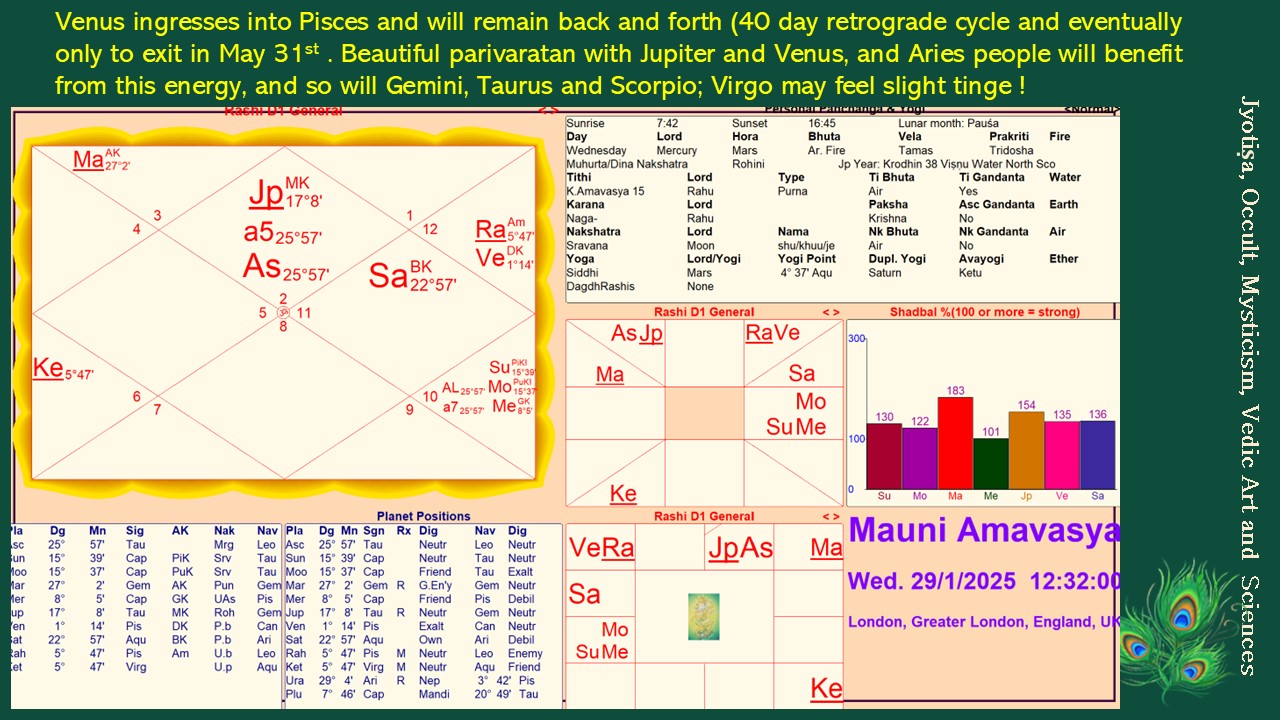
Happy New Moon Mauni (silent) Amāvāsya of 29th Jan 2025
is an extremely significant one for plenty of reasons. First off it come every year, no doubt, but this year is precious, as its is Maha Kumbha . kumbha literally means a pot for holding water. And of course it means the sign of Aquarius as well. The symbol of Kumbh is indeed linked with Aquarius itself, a guy holding a water pot signifying knowledge and pouring it.
The zodiac sign of Aquarius is the natural 11th house in the natal chart kundali. Some say it is the most important house, which is indeed the last house where the final ‘verdict’ is announced. As in the 12th house is the house of complete house of giving up, loss and ultimate Mukti, freedom. Hence, we can get liberated only when we are willing to give up all our possessions, our desires, acquisition, accomplishment, splendour and prosperity, profits good news. Hence, traditionally when someone dies, they often in the funeral procession throw money on the carriage, not because they can use it for after life, but, a reminder that all our world pursuits will come to naught.
Hence the 11th house of Aquarius becomes highly pertinent, as this is also the place where after having performed all our karma in the wider world, we are ready to ‘give that up’ for the Guru or any mentor or spiritual savant, who will guide you for the passage to the other worlds. Hence the house of Kumbha is where we will be judged and appropriate beating will be felt. So, what is the escape? Or rather the way out? Well, most human beings always want a short cut to their plight, and karmas accrued by them. One of the keys to this house, is penance, as being the house of Saturn as the ruler and the other ruler, who is the biggest ‘bhogi’ or the eternal enjoyer , which is North Node of the Moon, Rahu.
Saturn is always pleased with denial and abstinence of any kind, while for Rahu, that is the biggest challenge, as the nature of Rahu is about fulfilling desires. Denial is not in his book! So, this house by default demands some discipline to achieve something. What is the purpose for giving up? So, we can attain the ‘Shiva Tattva’ the principle of Shiva within ourself. Which is the seeking of ‘Brahman’ That needs self-knowledge – Atma Jnana. Hence the significator of this house is also Jupiter, and hence Jupiter becomes a huge player in the natural house of Aquarius.
So, how is this Atma Gnana achieved when we are lumbered with so many karmas and samskaras from many lifetimes? One of the finest way, is of course abstinence and use of water. That is how powerful water is, especially if the water is a flowing water from the head of Lord Shiva. Ganges.
This is what is stated in Skanda Purana Chapter 7 – The Seven Holy Cities.
The delighted Brāhmaṇa went to Prayāga, the king of holy places.
- That is the place where the two excellent rivers of black and white colours, viz., Yamunā and Gaṅgā are present. They are inaccessible even to Suras. By taking his holy ablution there, (even) a sinner realizes the highest Brahman.
- That is the holy place of Prajāpati inaccessible to all. Only through merits accumulated, is it obtained and not otherwise or through heaps of wealth.
- It is the place where the sacred celestial river (Gaṅgā) comes and meets the splendid river (Yamunā) having its source in the Kalinḍa Mountain, which suppresses (the evils of) the Kali age and the god of Death.
Thus, it is evident that the role of Nakshatras, Jupiter, Sun, Saturn, Venus and the Moon, is significant. As certain alignment is mandatory, so that the energies are conducive for ‘great Royal Bath in the Sacred rivers at Prayagraj’ is most powerful during certain times.
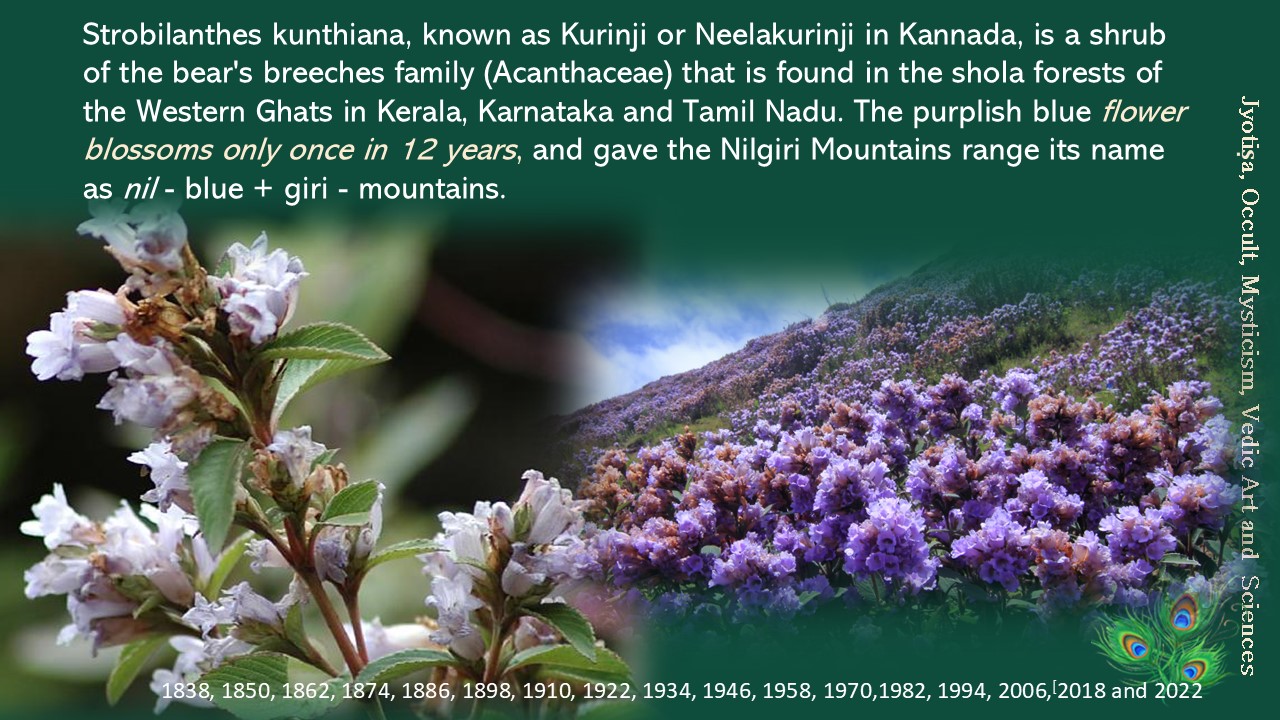
Thus when the entire 12 signs of the zodiac, starting from Aquarius, will come back to its similar alignment, when Jupiter and Sun along with Saturn, Moon are at certain aspects to each other. So this aspectual alignment, completes a long cycle of 144 years and returns back to where it started. Why is 12 important? Because we have 12 signs, Jupiter completes all twelve signs in 12 years. Nature gives us many clues. The flower Neelakurinji in Kannada, is a shrub of the bear’s breeches family (Acanthaceae) that is found in the shola forests of the Western Ghats in Kerala, Karnataka and Tamil Nadu. The purplish blue flower blossoms only once in 12 years, and gave the Nilgiri Mountains range its name as nil – blue + giri – mountains. The Colour of Aquarius is blue-purple, and mountains are ruled by Kumbha, Aquarius!
We wait for 12 days after someone dies, only on the 13th day is considered a significant mourning period, often referred to as “Terahvin” where a special ceremony is held to mark the end of intense mourning and to help guide the departed soul to dislodge the attachment to family, places etc and guide towards the afterlife through rituals and prayers. There are many more significations of 12.
Hence this Mauni Amāvāsya is doubly precious as the Maha Kumbha Mela, the great Aquarius festival is on, eventually ending on Maha Shivaratri on26th Feb 2025.
Certain key dates Soli-Lunar angles, like New Moon, Full moon, 5th and Sun’s entry into the sign of Capricorn, are all relevant for this festival where the prime purpose is for the common masses to avail of the great planetary alignment to balance their chakras, to hold the power to get rid of the situations in limbo or maybe in a plight of suffering or complete lack of direction and clarity in one’s life.
In a way the energies for all the 44 days are extremely powerful, but certain dates called the ‘Amrita Shahi Snana’ The great royal bath, is pertinent, as each of these impacts certain chakras in our bodies. So what are these chakras who resides and how does it activate?
Jala tattva the water element is one of the strongest forces on our planet,we as humans constitute over 60 % water. Our eyes, which is light, – Agni Fire is made of no less than 98 % water. Water becomes a vital conduit for energy transfer. Hence as Skanda Purana states,
- The word Prayāga means that which is superior to all Yāgas (sacrifices). Those who perform sacrifices there and get their bodies made wet by the river are not reborn.
- The trident and axe wielding Maheśvara is directly present there himself. It is he who points out the path of salvation to the living beings who take their holy dip there.
Experiments on Water
Flow of water is vital for cleansing and even the experiment by Masaru Emoto, was a Japanese researcher and author who conducted a series of experiments that aimed to reveal how human consciousness, words, and emotions can influence the molecular structure of water.
Emoto held that different water sources produced different ice structures. For example, he held that water from a mountain stream, when frozen, showed structures of beautifully shaped geometric designs; but that water from polluted sources created distorted, randomly formed ice structures. He held that these changes could be eliminated by exposing water to ultraviolet light or certain electromagnetic waves.
This is where it has been narrated in skanda, Kurma, Devi Bhagvatam and numerous other puranas as to how the water especially ganga, Saraswati and Yamuna meet, they form a phenomenal vortex of energies. As from all the Lokas all devatas and creatures come for making the Triveni – confluence of these rivers, which are present in the form of Nadis in our bodies.
So this Amavasya, do perform the pitris fire ritual , and donate, bag of rice, grain etc
This Amavasya also marks the start of the Gupt Navaratri, secret why? As this is for serious upasaks who authentically want to connect to the path of the divine…
Hence this Mauni (keeping mum) Amāvāsyā it is imperative of feeding and performing some fire ritual and performing tarpana.
Importance of Ganges cannot be overstated
O Nārada! Thus speaking, the Eternal Puruṣa Śrī Kṛṣṇa remained silent (i. e., the aerial incorporeal voice stopped). Hearing this, Brahmā, the Creator of the world, gladly informed Śiva of this. When the Lord of Knowledge, the Foremost of the Jñānins, Bhūtanātha heard the words of the Creator, He took the Ganges water in His hands and swore that “I will complete the Tantra Śastra, full of Rādhā mantras and not opposed to the Vedas. If one touches the Ganges water and speaks lies, one remains in the terrible Kālasutra hell for a period of one Brahmā’s life time.” O Dvija! When Bhagavān Śaṅkara said this before the assembly of the Devas in the region of Goloka, Śrī Kṛṣṇa appeared there with Rādhā. The Devas became exceedingly glad to see Him. They praised Him, the Best Puruṣa and they were all filled with rapture and again engaged themselves in the grand Rāsa Festival. Some time after, Māhā Deva lighted the Torch of Mukti, i.e., the Tantra Śāstra was published by Him, as promised. O Child! Thus I have disclosed to you this anecdote, so very secret, and hard to be attained. Thus Śrī Kṛṣṇa Himself, is verily the liquid Gaṅgā sprung in the region of Goloka. This holy Gaṅgā, born of the bodies of Kṛṣṇa and Rādhā inseparable from each other, grants enjoyment, lordship and liberation.
From the DeviBhagvatam
Chakras Activated on Holy Baths and the Yoginis associated with the CHakras for the Secret Gupt Navaratri
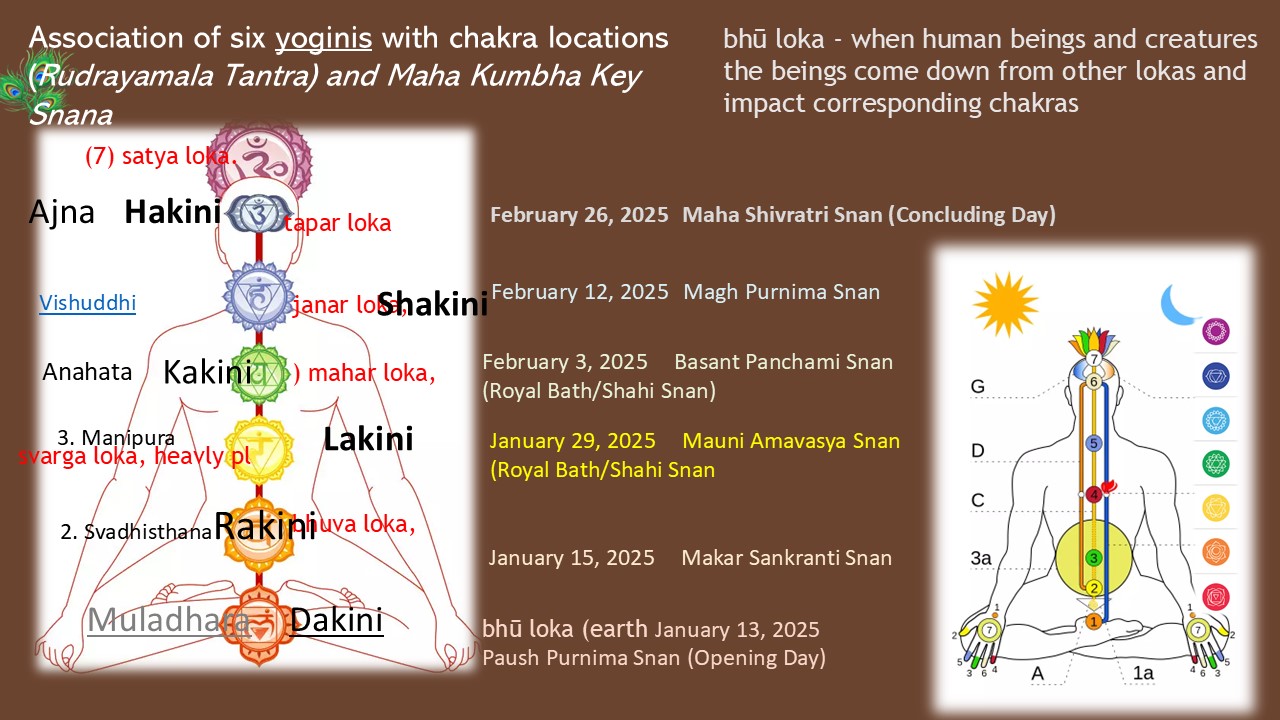
Yoginīcakra (योगिनीचक्र) refers to the “assembly of Yoginīs”, one of the sacred seats (pīṭha), according to the Manthānabhairavatantra, a vast sprawling work that belongs to a corpus of Tantric texts concerned with the worship of the goddess Kubjikā. So the Yoginis are similar to fierce sorceresses who are the helpers of the Mother Tripura Sundari, Lalita, Parvati.
Six female deities (yoginīs) are born from the central male deity (of the Yoginīcakra) known as Kuleśvara (‘the Lord of kula’):
- Ḍāmarī,
- Rāmaṇī,
- Lambakarṇī or Lambikā,
- Kākinī or Kākī,
- Sākinī,
- Yakṣiṇī
The seven upper cakras are as given below and they are mapped to the Yoginis above.
- mūlādhāra (base of spine): memory time and space;
- svādhiṣṭhana (below navel): reason;
- maṇipūra (solar plexus): will power;
- anāhata (heart centre): direct cognition;
- viśuddha (throat): divine love;
- ājñā (third eye): divine sight;
- sahasrāra (crown of head): illumination, Godliness.
Ḍākinī with the mūlādhāra chakra, Rākinī with svādhiṣṭhāna, Lākinī with maṇipūra, Kākinī with anāhata, Śākinī with viśuddhi, and Hākinī with ājñā. The Śrīmatottara Tantra places Kusumamāla (absent in the Rudrayāmala Tantra) at the feet, while other texts place a figure named Yākinī at the level of the sahasrāra.
The seven lower cakras are:— Essentially , one lands in one of these places after death, depending on the graveness and gravity of the Sins..
- atala (hips): fear and lust;
- vitala (thighs); raging anger;
- sutala (knees); retaliatory jealousy;
- talātala (calves): prolonged mental confusion;
- rasātala (ankles): selfishness;
- mahātala (feet); absence of consciousness;
- pātāla (located in the soles of the feet): murder and malice.
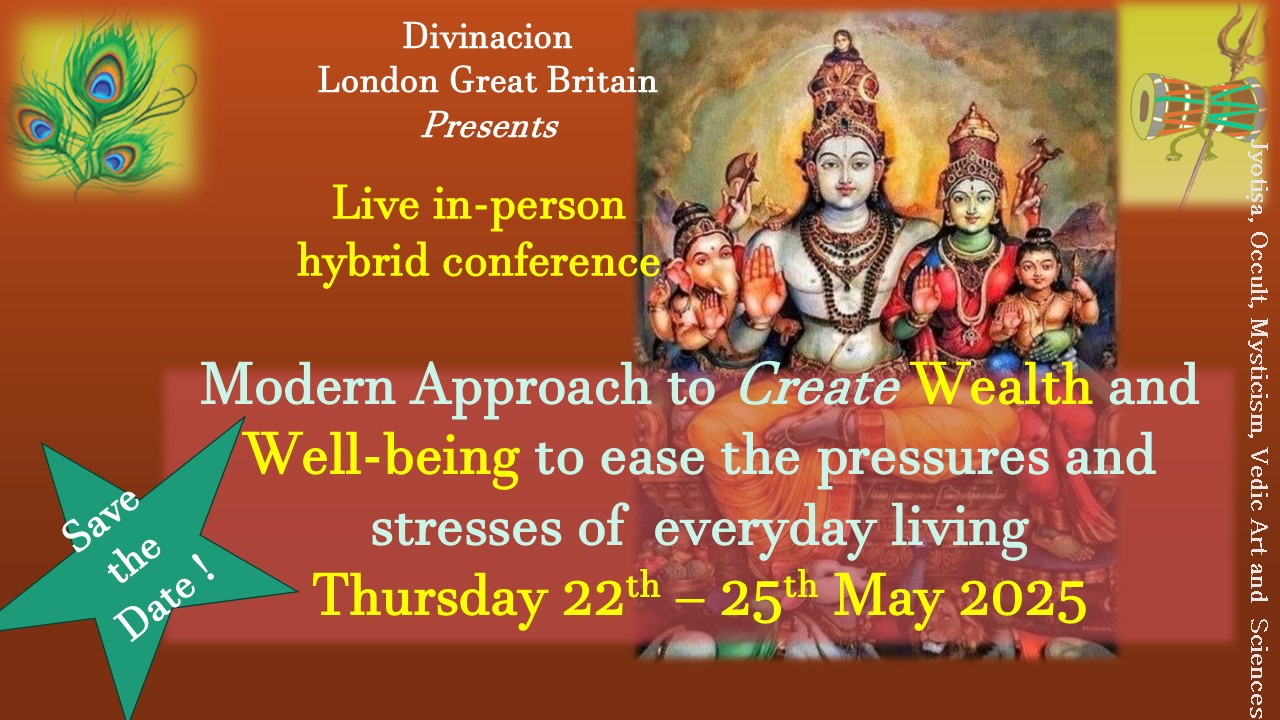
Registrations to open shortly. Save the Date…