Why Chāturdaśa fourteen years of exile for Sri Rāma ?
The Vedanga Jyotisha and Spiritual Significance of Chaudaha baras for our Earthly Existence
Ayodhaya Conference on Rāmāyaṇa Jyotisha 11- 15 December 2023

Sonal Sachdeva – Namaskaram to all the Gurus and Pandit Sanjay Rath and Srimati Sarbani Rath for this hallowed conference and JagatGuru RāmaBhadracharya for the inspiration behind this talk that set me on a path of research the talk to be delivered on Friday 15th December 2023 at 4:30 pm at Ayodhya.
‘Spiritual and JyotiṣaVedāṅga Perspective on the signification of Caudaha (चौदह) baras 14 Years of Vanavas Exile of ŚrīRāma in the classical Bharatiya granth Rāmāyaṇa’
बुध बिश्राम सकल जन रंजनि। रामकथा कलि कलुष बिभंजनि॥
रामकथा कलि पंनग भरनी। पुनि बिबेक पावक कहुँ अरनी॥3॥
budha biśrāma sakala jana raṃjani. rāmakathā kali kaluṣa bibhaṃjani.
rāmakathā kali paṃnaga bharanī. puni bibēka pāvaka kahuom aranī.
The story of Rama is a solace to the learned and a source of delight to all men and wipes out the impurities of the Kali age. ŚrīRāma’s story is a peahen for the serpent in the form of the Kali age; again, it is a wooden stick for kindling the sacred fire of wisdom.
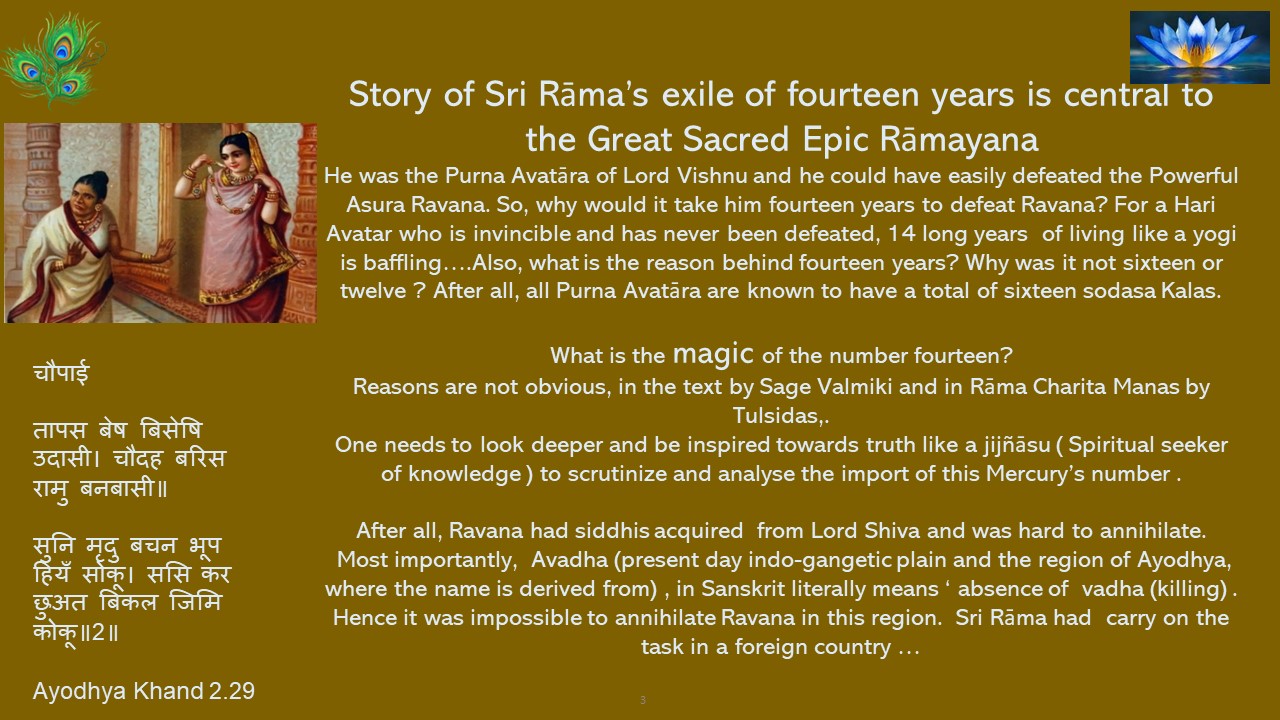
Śrī Rāma’s exile of fourteen years is central to the Great Sacred Epic Ramayana
He was the Purna Avatāra of Lord Vishnu, and he could have easily defeated the Powerful Asura Ravana. So, why would it take him fourteen years to defeat Ravana? For a Hari Avatar who is invincible and has never been defeated, 14 long years of living like a yogi is baffling…. Also, what is the reason behind fourteen years? Why was it not sixteen or twelve? After all, all Purna Avatāra are known to have a total of sixteen sodasa Kalas (talents, gift). So why the chaudaha 14 years of banabas exile?
Daśaratha, famous King belonging to the Ikṣvāku dynasty. He was the father of Śrī Rāma. From the genealogical point of view, he descended from Viṣṇu in the following order. Brahmā—Marīci—Kaśyapa—Vivasvān—Vaivasvata Manu—Ikṣvāku and so on and so forth.
So, we are aware that Lord Brahmā has a lot to do with the transpiring of ŚrīRāma’s exile, or was it perhaps of Goddess Saraswati? Did Saraswati put the idea in the head of Kaikeyī to ask from her husband, Daśaratha, that ŚrīRāma be banished for 14 years. But then we wonder why Goddess of Learning, Saraswati had to interfere….
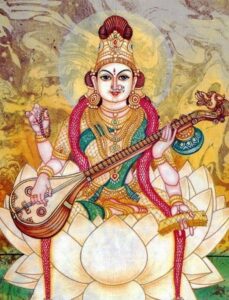
Brahma’s consort Sri Maha Saraswati is the greatest devotee of ŚrīRāma and requested Brahma to orchestrate the exile years through the mind of Kaikeyī.
Later of course, Kaikeyī was forgiven by both Ram and Bharat, Ram returned from his 14-year exile. She stayed long in the palace.
In next Yuga, she was reborn as the birth mother Devki to Lord Krishna who because of her karmas of previous lifetime, had to forego the happiness and pleasure of raising baby Krishna.
Interestingly, there are differences in how Dasaratha Clan perceived the fourteen years of exile. Some broke it into nine and five years (still amounting to the 14). One of the verses, ŚrīRāma broke the news to Mother Kaushalya as Nava Pancha as in nine years and five years.
Kaikayi to Dashratha (2.11.26):
नव प़ञ्च च वर्षाणि दण्डकारण्यमाश्रितः। चीराजिनजटाधारी रामो भवतु तापसः।।
Rama must take refuge in the forest of Dandaka for nine years and five years and let him become an ascetic wearing rags, deer skin and matted hair”.
Here the Nava pancha (nine five = 14) is very much in keeping with the trikona of ŚrīRāma’s Jyotisha Chart, with Moon and exalted Jupiter in trines to exalted Venus in Pisces.
Yet, the mystery of Caturdaśa, (sanskrit for 14) years remain.
Significances of Caturdaśa, in Brahma’s creation.
Lord Brahma’s creations is through the prajapatis, who were instrumental in creating Manus. Caturdaśamanu, refers to the fourteen successive mythical progenitors and sovereigns of the Earth. We already know ŚrīRāma belonged to the dynasty all the way going to Lord Brahma.
SB 4.24.67
kas tvat-padabjam vijahati pandito yas te ’vamana-vyayamana-ketanah
visankayasmad-gurur arcati sma yad vinopapattim manavas caturdasa
Translation by His Divine Grace A. C. Bhaktivedanta Swami Srila Prabhupada:
My dear Lord, any learned person knows that unless he worships You, his entire life is spoiled. Knowing this, how could he give up worshiping Your lotus feet? Even our father and spiritual master, Lord Brahma, unhesitatingly worshiped You, and the fourteen Manus followed in his footsteps.
Of course, we cannot just talk of the 14 Manus and not speak of the 14 Manvantaras.
In Tattvartha sūtra 3.23: Chapter 3 Verse 3.23 – The tributaries of the rivers
चतुर्दशनदीसहस्रपरिवृता गंगासिन्ध्वादयो नद्यः ॥ ३.२३ ॥
caturdaśanadīsahasraparivṛtā gaṃgāsindhvādayo nadyaḥ || 3.23 ||
The rivers Gaṅgā, Sindhu, etc., have 14,000 tributaries.
Commentary by Ācārya Pūjyapāda’s Sarvārthasiddhi
States that the tributaries of rivers are enumerated in this sūtra. Why should ‘Gaṅgā, Sindhu, etc.,’ be mentioned in the sūtra? It is to include these rivers. But are these rivers, the subject of description, not naturally included? According to this principle this would include only the western rivers. The term ‘Gaṅgā, etc.,’ would include only the eastern rivers. Hence ‘Gaṅgā, Sindhu, etc.,’ is used to include both. Therefore, river Gaṅgā and river Sindhu, each, has 14,000 tributaries. The groups of rivers in the other regions have twice the number of tributaries up to the Videha region. Beyond that the tributaries are less by half the number. This means that rivers Rohita and Rohitāsyā, each, has 28,000 tributaries. Rivers Harit and Harikāntā, each, has 56,000 tributaries. Rivers Sītā and Sītodā, each, has 1,12,000 tributaries. Rivers Nārī and Narakāntā, each, has 56,000 tributaries. Rivers Suvarṇakūlā and Rūpyakūlā, each, has 28,000 tributaries. And rivers Raktā and Raktodā, each, has 14,000 tributaries.
Rivers are of great importance in Ramayana, as ŚrīRāma, had to take the services of Sri Hanumat and the entire vanar sena to cross the sea. Most importantly, Avadh (present day Indo-Gangetic plain and the region of Ayodhya, where the name is derived from), in Sanskrit literally means ‘absence of vadha (killing). Hence it was impossible to annihilate Ravana in this region. ŚrīRāma had to carry on the task in a foreign country …Sri Sita, although she is the bhumi putri daughter, but she is the personification of Jala, the water element. Agni, Fire Surya Tejaswi putra ŚrīRāma must overcome the jala tattva, to reach his rescue mission. This is a spiritual lesson for every human being, the tug of war between the fire Agni and the Jala. The Agni of the belly, manipura, needs to be channelled upward, including the kundalini shakti, (residing are the muladhara chakra). Hence the jala of the swadhistana, needs to travel in higher chakras, to purify and transform into the sattvic energy. That is also the reason that the seven chakras, exist in the human body, that map to the seven Lokas above us, and seven Lokas below us.
Taking the count of the Lokas to 14.
In SrimadBhagvatam 9.20.28
mrgañ chukla-datah krsnan hiranyena parivrtan
adat karmani masnare niyutani caturdasa
Translation by His Divine Grace A. C. Bhaktivedanta Swami Srila Prabhupada:
When Maharaja Bharata performed the sacrifice known as Masnara [or a sacrifice in the place known as Masnara], he gave in charity fourteen lakhs of excellent elephants with white tusks and black bodies, completely covered with golden ornaments.
Fourteen abodes of knowledge that constitutes Sanatana Hindu Dharma.
Caturdaśan (चतुर्दशन्) are the “fourteen foundations of knowledge and religion, according to the Yājñavalkyasmṛti.
“The four Vedas along with the Four Upangas Purāṇas, Nyāya, Mīmāṃsa, Dharmaśāstras and the six auxiliaries (limbs of the Vedas are the fourteen (caturdaśan) foundations of knowledge and religion”. These fourteen dharma-pramanas are called ” Caturdaśa-vidyā.
Man possesses several angas or limbs. In the same way the Vedas personified — the Vedapurusa — has six limbs. (It must be noted that the Vedas are also spoken of as Vedamatha, Mother Veda.) The four Upangas, though not integral to the Vedas, are supporting limbs of the Vedapurusa.
The Nakshatra Purusa and the Dhruva Maṇḍalam
Inspired from the devi Bhagavata Purana, in Chapter 17, states that the luminaries do not fall to the ground, as they are kept up in their respective positions by the favour of the union of Prakriti and Puruṣa. Some opine that this Jyotiṣcakra, the celestial Heavens – the Zodiac is Śiśumāra. It is kept duly in its position for the purpose of holding things up by the power of the Bhagavān. It is resting with its body coiled round and with its head lower down.
O Muni! Dhruva, the son of Uttānapāda is staying at the tail end. And, in addition to him, also at the tail rests Brahmā, the Sinless Prajāpati, worshipped by the Gods, Agni, Indra and Dharma. Thus, the creation is at the tail and the Saptarṣi maṇḍal is staying at his waist. Thus, the celestial wheel (Jyotiṣcakra) is resting with his coils turned in a right-hand direction.
On his right side are found the Uttarāyaṇa Nakṣatras, fourteen in number from Abhijit to Punarvasu and on his left side are found the other fourteen Dakṣiṇāyanam Nakṣatras from Puṣyā to Uttarāṣāḍhā. O Son of Brahmā! Thus, the Nakṣatras form the coil-shaped body of the Śiśumāra, the Zodiac; half the Nakṣatras on the one side and the other half Nakṣatras on the other.
His back is on the Heavenly Ganges named Ajavīthī. Punarvasu and Puṣyā form the right and left side of the loins; Ārdrā and Aśleśā form the right and left feet (westward); Abhijit and Uttarāṣāḍha form the right and left nostrils. O Devarṣi! Śravaṇā and Pūrvāṣāḍhā form the right and left eyes respectively; so, say the persons that form the Kalpanās (fancies). Dhaniṣṭhā and Mūlā form his right and left ears; Maghā, etc., the eight Dakṣiṇāyanam Nakṣattras form the bones on the left side. O Muni! Mrigasīrṣa, the Uttarāyaṇa Nakṣattras form the bones on his right side, Śatabhiṣā and Jyeṣṭhā form the right and left shoulders.
There is a very famous phrase from the ancient literature Charaka Samhita means that whatever entities that are present in this universe are present in the individual too. The composition of Man and the universe is one and same.
यावन्तः हि लोके भावविशेषाः तावन्तः पुरुषे।
यावन्तः पुरुषे तावन्तः लोके। (च० शा० – 5/3)
Hence, whatever formed entities are in universe, the same are in human body, the same are in human being and what so ever entities are in human being those are in universe. Charaka Samhita Sharira Sthan 5/3
Through this talk we see the magic of the number fourteen. Reasons are not obvious, in the text by Sage Valmiki and in Rama Charita Manas by Tulsidas.
One needs to look deeper and be inspired towards truth like a jijñāsu (Spiritual seeker of knowledge) to scrutinize and analyse the import of this Mercury’s number. (1+4 equals 5).
The talk will bring in chaupai / shlokas from across the Vedas, the puranas and samhitas, Rama Rahasya Upanishad and the Brahma Sutras to support how and why the purpose of those number of years for ŚrīRāma in his exile accompanied by his brother Lakshman and wife Sita, had to be fourteen years to kill Ravana.
After all, Ravana had siddhis acquired from Lord Shiva and was hard to annihilate. Ravana had sung 14 Māheśvarī Sutras to get Lord Shiva’s attention and played the dumroo 14 times between Lord Shiva Tandava.