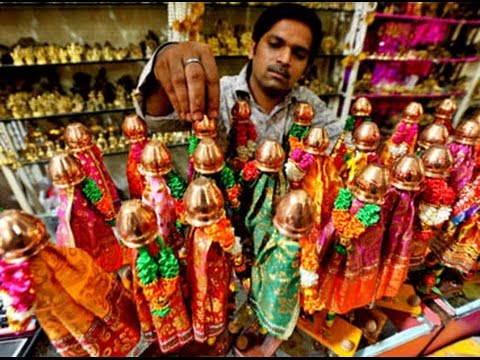
Gudi- Dolls are displayed in window sills to mark the auspicous New year with people buying some form of Gold or Silver and having a feast!
Chaitra Shukla Pratipad – Gudi Padva – The great Happy New year and start of the 9 Days Navratri ending in the birthday tithi of Lord Rama Ram Navami
Chaitra shukla pratipada – Literally means the first day after the new moon,in the month of Chaitra as per the Indian Hindu Almanac.First day of the waxing phase (shukla) marking the beginning of the spring harvest and extremely aupisious time for a New year to begin.
A new year which sets the tone for the rest of the year, as per the Vikram samvat year.Vikram Samvat is based on the day when Vikramaditya defeated Sakas and invaded Ujjain. astronomers formed new calendar based on luni-solar system that was very much near to accuracy, is still followed in the Northern regions of India and some western parts of the country.
Yet the Hindus celebrate the first nine lunar days nearest to both the Vernal and Autumnal equinoxes. Both these times are sacred as the Navaratris.
It marks the spring equinox and very auspicious time as it heralds a 9-day worship of Durga. Navratri, or the 9 day and nights, is one of the longest Hindu festivals, spanning over nine nights and ten days. In a year, Navratri comes four times-one each in the months of Chaitra, Aashadh, Ashwin and Magha.The Navratri that falls in Chaitra in the Spring Months in March or April is very auspicious as this culminates in the ninth day is celebrated as Ram Navami, birth of Shri Ram. He slayed all the demons these 9 days with the help of the Durga-Shakti. And hence it is a great time for a spiritual practise with its culmination on Ram Navami, the 9th day.Though the Autumnal Navaratris are celebrated in a major way Dipalwali/ Dusshera Navaratris, ardent worshippers of Sakti fast and chant the ‘Devi Mahatmyam’ during the Vasanta Navaratris too.
The Hindu New Year (referred to as ‘Ugadi’ or ‘Yugadi’ in Telugu) marks the beginning of the Vasanta (spring) Nava-ratris and ‘Sri Rama Navami’ marks the climax. It is not a mere coincidence that Sri Rama Navami marks the climax of the Spring Navaratris. Among the incarnations of Visnu, Parasara identifies Sri Rama with Sun.
In fact ‘Samvatsara’ and ‘Kala’ are depictions of Prajapati and embodiment of Lord Brahma. Typically, a period of a year is ruled by Saturn. In Saivite tradition too, Time is personified as Siva – as Mahakala, the Great (God of) Time which is beyond all destruction or creation, and has no beginning or an end – in short it is infinite.
Nearly every festival in Hinduism has an astronomically linked with the Panchang or the Indian Almanc and is icorportated in everyday life. Hence the importance of Jyotisha!
Most ancient cultures had festivals based on astronomical events, especially the Sun or Moon. Let us take the Sun. There are four landmarks in the Sun’s journey in the heavens.
Vernal equinox
Autumnal Equinox
Summer solstice
Winter solstice
Vernal and Autumnal equinoxe is when the Hindus celebrate the first lunar day nearest to the Vernal equinox as New Year, Both these times are sacred and begin 9 days before representing the various forms of Shakti Durga, in form of Nava Durgas. or The first nine lunar days closest to the Spring equinox are celebrated as Vasanta (Spring) Navaratris while the first nine lunar days closest to Autumnal equinox are celebrated as the Sharad Autumn Navaratris (nine nights)
The Autumnal Navaratris are celebrated in a major way by all hindus as the Dusshera Navaratris, ardent worshippers of Sakti fast and chant the ‘Devi Mahatmyam’ during the Vasanta Navaratris too. The Hindu New Year (referred to as ‘Ugadi’ or ‘Yugadi’ in Telugu) marks the beginning of the Vasanta (spring) Navaratris and ‘Sri Rama Navami’, [the Birth Soli-Lunar Tithi (Phase of Moon) of Lord Rama], marks the climax.
The division of time is an important topic in the Puranas as well as Agamas. In its most fundamental form the division of time is based on the movement of astronomical bodies, especially the luminaries i.e. the Sun and the Moon. Astrologically speaking Hinduism recognises at least five ways of reckoning the year Sāṃvatsara
- Nakshatramana pertaining to Nakshatras
- Souramana Solar based
- Chandramana Lunar basis
- Savamana
- Brihaspatyamana Jupiter motion
(Vedanga Jyotisham pf Sage Lagadha and Brhat Samhita )
In other states like Andhra Pradesh and Maharashtra the New Year is celebrated according to Chandramana. Astrologically speaking Chandramana is the accepted system in Hinduism. As is obvious, Chandramana is based on the Moon.
Thus during the month of Chaitra the full moon is in Chitra nakshatra (Virgo) while the New Moon is in Pisces. In other words in the month of Chaitra the Moon and Sun are in Pisces on the first day of the month and the Full moon occurs in Chitra nakshatra in Virgo.Chaitra Masa month is selected as New Year is on the first lunar day following the new moon nearest to the Vernal (spring) equinox, thus making it Soli-Lunar in nature.
Sāṃvatsara
Sāṃvatsara (सांवत्सर) refers to an “astrologer”, according to the Bṛhatsaṃhitā (chapter 2), an monumental work on Astronomy and Astrology written in Sanskrit by Varāhamihira. According to Varahmihira, he mentions in his text that “As is the night without a lamp and the sky without the sun, so is a prince without a Jyotiṣaka [i.e., sāṃvatsara—asāṃvatsara] and he gropes his way in the dark.”
If there were no Jyotiṣakas [i.e., sāṃvatsara], the muhūrtas, the tithis, the nakṣatras, the ṛtus and the āyanas would go wrong”! Such is the importance of the year Sāṃvatsara which refers to five years of each yuga of Jupiter’s cycle, according to the Bṛhatsaṃhitā (chapter 8).
He further states that the “The five years of each yuga are known as—
1. Saṃvatsara, 2. Parivatsara, 3. Idāvatsara, 4. Anuvatsara, 5. Idvatsara. These are sacred respectively to
1. Agni (fire), 2. Arka (the Sun), 3. Candra (the Moon), 4. Prajāpati (the Creator), 5. Rudra (the Destroyer)”
According to legend, Naradi (the name of Nārada after he transformed into a woman)
Sage Narada in his conversation with Lord Krishna mentioned he wanted to experience the Grand Illusion – Maya. So lord Krsna promptly turned him into Naradi – Cowherd Gopi, a young maiden. He, actually She got married gave birth to sixty sons each year. Worried, exhausted, fatigued, bored to death by these numerous sons, Naradi at the end of the sixtieth year involuntarily prayed to Lord Vishnu. Transformed back, Narada appealed to Vishnu to silence his sixty sons. Vishnu gave them the rulership of the world to be enjoyed for one year at a time. This is how each Hindu year has a separate name for a cycle of sixty years.
| 1.Prabhav,
2.Vibhav, 3.Shukla, 4.Paramoda, 5.Prajapati, 6.Angira, 7.Shrimukha, 8.Bhava, 9.Yuva, 10.Dhatu, 11.Ishwar, 12.Bahudanya, 13.Pramathi, 14.Vikrama, 15.Vrisha, 16.Chitrabhanu, 17.Subhanu, 18.Taran, 19.Prartiva, 20.Vyaya, |
21Sarvajit,
22.Sarvadhari, 23.Virodhi, 24.Vikriti, 25.Khara, 26.Nandana, 27.Vijaya, 28.Jaya, 29.Marmath, 30.Durmikha, 31Hemalambi, 32Vilambi, 33.Vikari, 34.Sharvar, 35.Plava, 36.Shubakrit,37.ShobhaKrut, 38.Krodhi, 39.Vishvavasu 40.Parabhava |
41,Plavanga,
42.Kilaka, 43.Saumya, 44.Sadharana, 45.Virodhikrita, 46.Paridhavi, 47.Pramadi, 48.Ananda, 49.Rakshasa, 50.Nala, 51.Pingala, 52.Kalayukta, 53.Sitdharti, 54.Raudri, 55.Durmati, 56.Dundubhi, 57.Rudhirodgari, 58.Raktakshi, 59.Krodhana, 60.Akshaya |
Year 2022
This Year it is on Friday 1st April 2022. This Samvatsara is also ShubhaKrit. More on the Significations of the Jovian Jupiter Cycles you are born click here. It lists every year and what it entails.
- Shubhakruth: The native getting birth in the ‘Samvatsara’ of ‘Shubhakruth’ is endowed with good fortune, learning, courtesy or humility and excellent virtuous deeds, is long-lived and has many sons and much wealth and property.
According with Jataka Parijata, the person born in the year Shubhakruth (2022-2023 AD) will be dupe of women, but learned, handsome and intelligent.
Notes: ‘Shubhakruth’ may be spoken as ‘Shubha’ also. ‘Shubha’ means auspicious or good and ‘Shubhakruth’ means the doing of the deeds of auspiciousness or goodness. Such a native has religious ideas and he performs religious and virtuous deeds also. Besides this, he is adroit or skilled in the work he performs. One born in this Samvatsara, will be well versed in his work, reputed, religious and also an ascetic person. He will take care of his people and be proficient in his dealings.
Notes: Yavana Jataka holds views which are compatible to the name, like he will be highly fortunate and benefactor to others, learned and noble person who will have good longevity and will yearn for opulence and children. Mundane results are that the populace will rejoice and have prosperous time.
Commentary – This Year 2022 & 2023 which has auspicious (Shubha) may be actually a respite of a couple of years after which we may be head long into a War like Situation. Next two years no doubt may be start of slight economic downturn, but with the Advent of 2024 – which is Krodhi, may be a start of a not so nice ! In fact it may be quite a turbulent year.
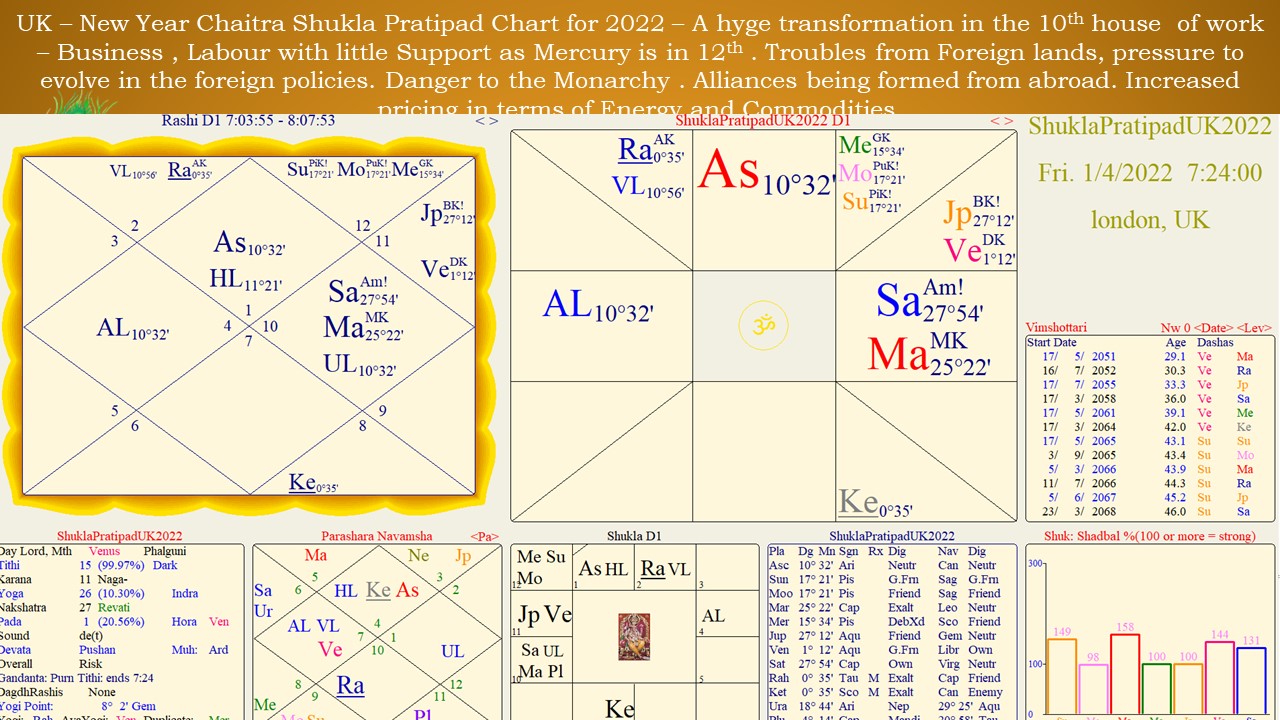
Chaitra Shukla Pratipad for UK 2022
Chaitra Shukla Pratipad Chart for UK 2020
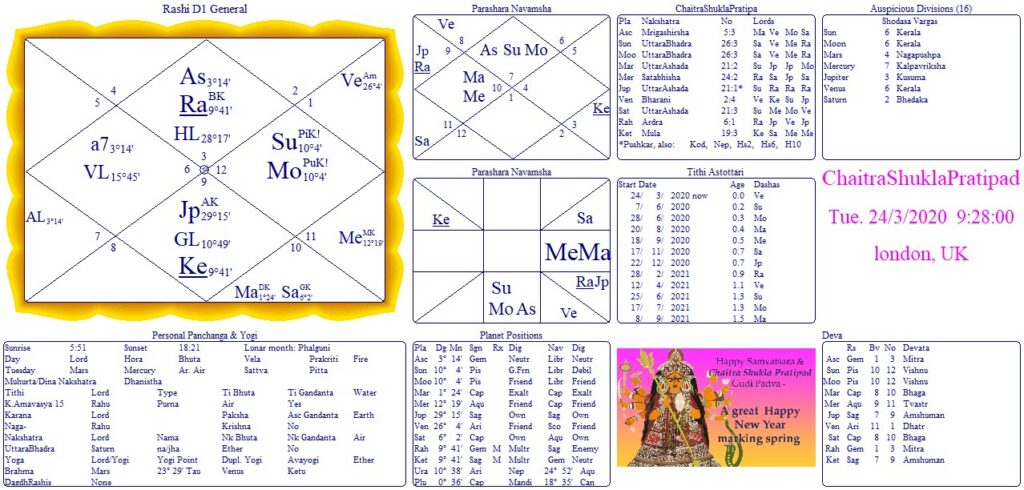
This sets the course for the rest of the year, for the United kingdom. One can do this for all country horoscoscopes.
Here there is a parivartana between rahu and Mercury, thus making Rahu go to MKS, so seemingly when the Rahu Period later in the year comes along, expect chaos and mayhem. Venus period currently iis keeping us captive in our own homes and stopping from situation to become chronic. As Mars, the ruler of aries is in a Yama Yoga in 8th. Finance, stocks treasury etc, will go through huge death like states. Which needless to say we are experiencing.
Relief may come when it enters Sun period, as it is in Digbala. Of course a very potent Kal Sarpa Yoga in the collective. It is people who will suffer the most, 7th house. As Moon the ruler of 2nd is in 10th and Jupiter its lord is in the 7th house with Ketu. Perhaps, there would be alternate measures coming through, and we will undoubtedly change the way we work, live and what we do. This is no mean task on a collective level, and no doubt , we will be forever ttransformed as a result.
The spring equinox marks the beginning of Navaratri and it is one of the fnest times to worship the Nine various forms of Goddess Durga
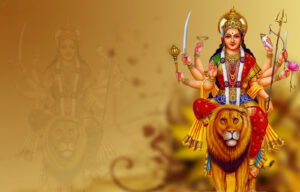
The spring equinox marks the beginning of Navaratri and it is one of the fnest times to worship the Nine various forms of Goddess Durga
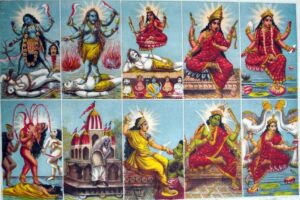
25th March- First day of Navratri – Pratipada – Goddess Shailputri
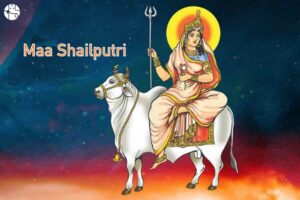
Mantra for the first day of Navratri: Om Sham Shailputraye Namah.
Also,
- ॐ देवी शैलपुत्र्यै नमः॥
- Om Devi Shailaputryai Namah॥
Prarthana or Prayer of Shailaputri
- वन्दे वाञ्छितलाभाय चन्द्रार्ध कृतशेखराम् ।
- वृषारूढाम् शूलधराम् शैलपुत्रीम् यशस्विनीम् ॥
- Vande Vanchhitalabhaya Chandrardhakritashekharam।
- Vrisharudham Shuladharam Shailaputrim Yashasvinim॥
“I pay my VANDANA/obeisance to the divine mother Shailaputri, who bestows upon the choicest boons to the devotees. The moon in the crescent form is adorned as the crown on Her forehead. She is mounted on the bullock. She holds a lance in her hand. She is Yashasvini, celebrated mother divine”
Second day – Dwitiya – Goddess Brahmacharini
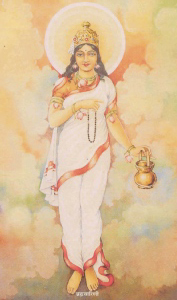
Third-Day – Tritiya – Chandraghanta
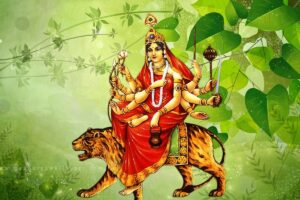
Fourth Day of Navaratri – Chaturthi thithi–
Goddess Kushmanda
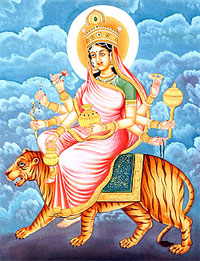
Fifth Day of Navaratri – Panchami Tithi –Goddess Skandamata
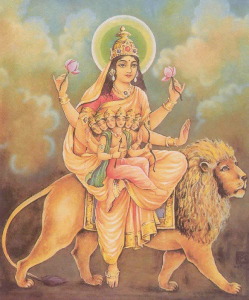
30th March- Sixth day – Shashthi date – mother Katyayani
Seventh-day – Saptami Tithi – Worship of Goddess Kalratri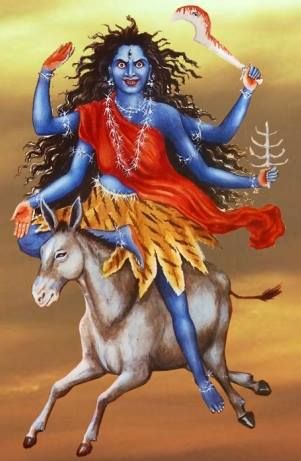
8th day – Ashtami Tithi – Goddess Mahagauri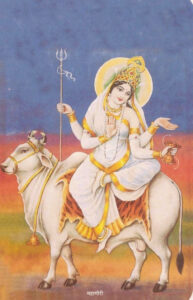
Ninth Day – Navami Date – Goddess Siddhidatri
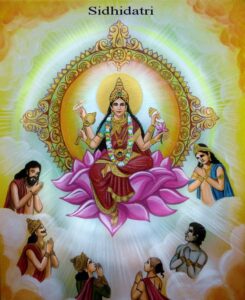
Durga Saptashati reading/chanting is very popular way to connect with the various forms of Durga. Recommended only for next 9 days of Navaratri.